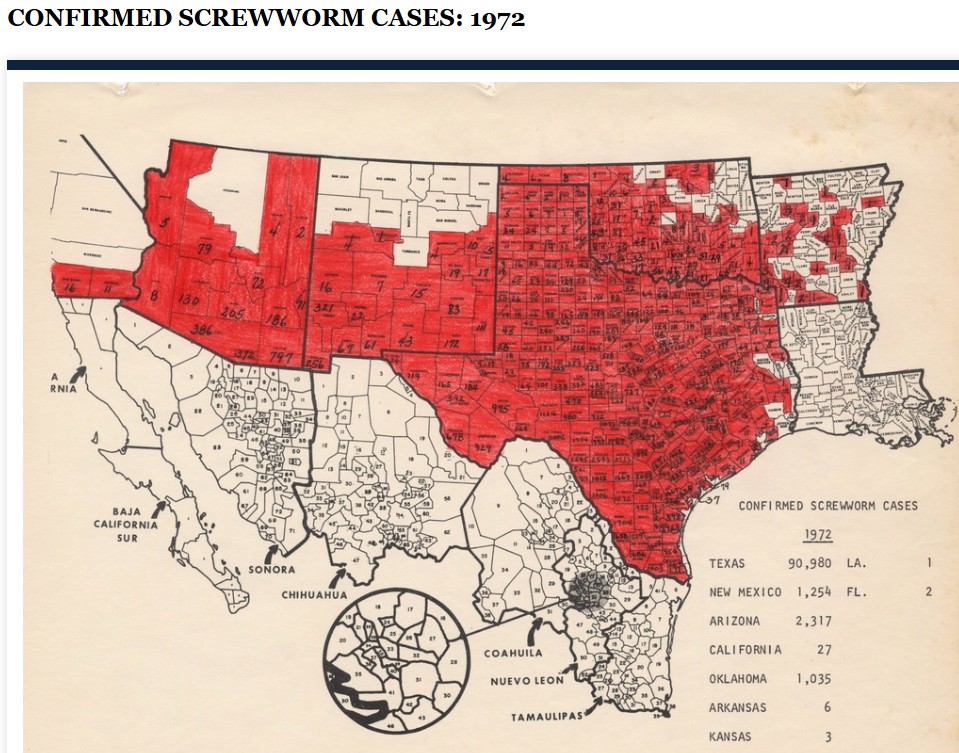
Image Source: USDA
The current situation illustrates that it just takes a brief lapse in control measures for NWS to once again advance.
Derrell S. Peel, Oklahoma State University
The reemergence of New World Screwworm (NWS) in the U.S. has prompted much discussion about eradicating the pest once again after having the country NWS-free for over 40 years. Sometimes overlooked or not understood is the fact that the battle has never stopped. Eradication of NWS from a particular region is a matter of pushing the boundary away from the region and maintaining it with sterile fly dispersals. After NWS was eliminated from the U.S. in 1966, NWS continued to be a problem in the U.S. because the barrier at the U.S.-Mexican border was too long and impossible to maintain. A major NWS outbreak in 1972 spurred the U.S. and Mexico to increase cooperation with a goal of eliminating NWS from both countries.
Figure 1 above shows that more than 90,000 cases of NWS were reported in Texas alone in 1972. Progress in pushing NWS south in Mexico eventually resulted in the last case of NWS in the U.S. in 1982. The sterile fly facility in Mission, Texas was replaced with a new facility in Tuxtla, Mexico.
As the NWS barrier in Mexico approached the 93rd Meridien (Isthmus of Tehuantepec), the decision was made to extend the NWS barrier south through Central America. Mexico was declared NWS-free in 1991. Progress in pushing the NWS barrier south through Central America led to the decision to establish the permanent barrier in Panama against the endemic NWS presence in South America.
Eventually a new sterile fly facility was located in Panama, replacing the Mexican facility. The Panama facility (COPEG) has continued to produce and disperse trillions of sterile NWS flies since then. Central and North America north of the Darien region of Panama has been NWS-free since 2004. In 2023, NWS breeched the barrier in Panama and moved rather quickly north through the Central American countries; back in Mexico by November 2024; across Mexico in 2025 and into the U.S. once again in June 2026. The U.S., Mexico and the Central American countries once again face the challenge of pushing NWS south. The history of NWS highlights the fact that the battle never stops – it is simply a question of where the front lines are located.
The current situation illustrates that it just takes a brief lapse for NWS to once again advance. Changing cattle market conditions and demands likely contributed to more movement and cattle movement through areas not covered by sterile fly coverage. There is little doubt that human transport (both legal and illegal) of cattle (and possibly horses) contributed to the rapid advance of NWS across Central America. Once in Mexico it spread rapidly, in part because the Mexican cattle market has evolved in recent years to include much more movement of cattle across the country.
It was beneficial before to control NWS and establish the barrier in Panama. It will be worth it again and that means that joint efforts and cooperation between the U.S., Mexico and Central America will be critical. The battle against NWS is fundamentally different than eradication efforts against diseases such as Brucellosis and Bovine Tuberculosis, where successful eradication efforts are replaced by on-going surveillance programs. The battle against NWS never stops and thus it is important to determine where the front line will be maintained and operated, recognizing continued evolution of cattle production and marketing in all regions.