Beef production is projected to decrease in the top four beef producing countries: Brazil, U.S., China and the E.U., as well as in Argentina.
Derrell S. Peel, Oklahoma State University
The latest FAS-USDA report on “Livestock and Poultry: World Markets and Trade” shows global beef production at 61.563 million metric tons (mmt), down 1.1 percent from 2025.
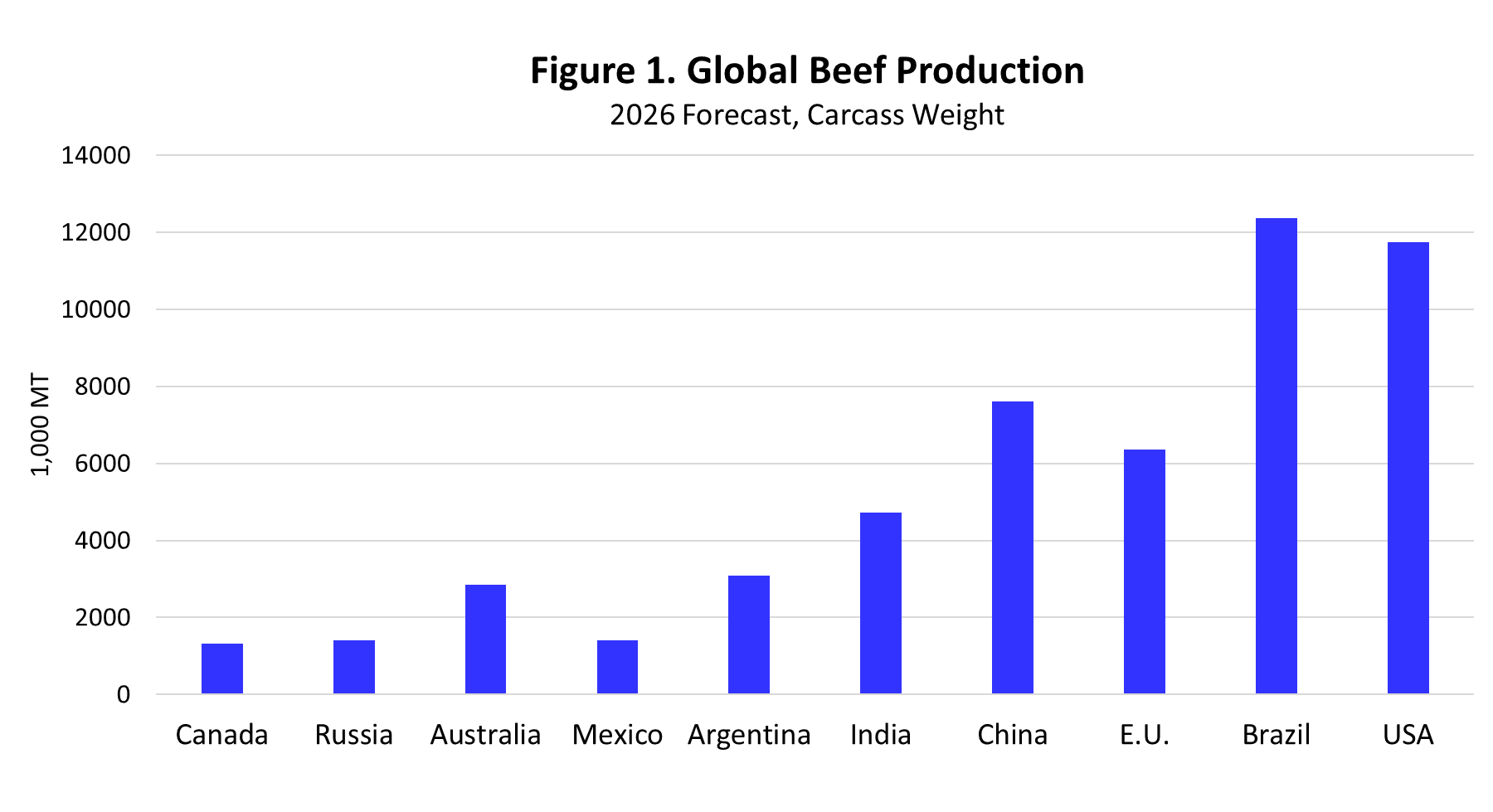
Beef production is projected to decrease in the top four beef producing countries: Brazil, U.S., China and the E.U., as well as in Argentina (Figure 1 above). Beef production is projected to increase in India, Mexico, and Canada.
Brazil surpassed the U.S. as the largest beef producing country in 2025 and is projected higher in 2026. Figure 2 shows the shares of global beef production for each of the top five beef producers since 1980. Brazil has shown the most dramatic growth in beef production over many years, along with China and India. The European Union has decreased, as has the U.S. as a share of global beef production. Since 1980, global beef production has increased 43.4 percent, and average increase of 0.8 percent per year.
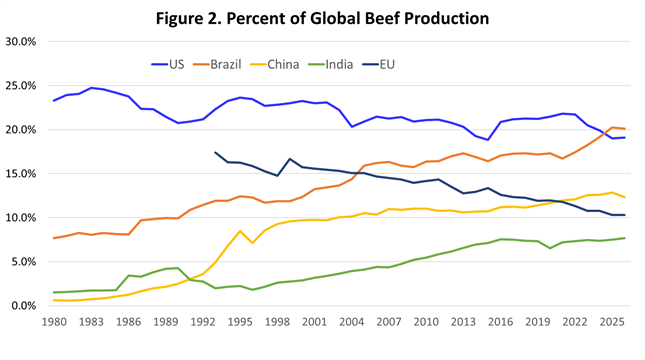
Figure 3 shows projected 2026 beef exports for the major beef exporting countries. Total beef exports are expected to decrease 0.8 percent from the record 2025 global beef exports. Global beef exports have increased by 205 percent since 1980, an average of 2.7 percent annually.
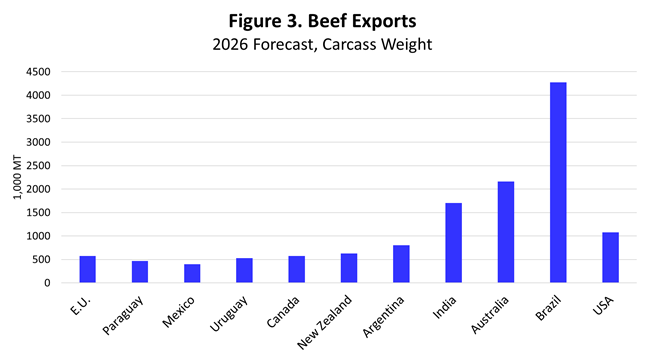
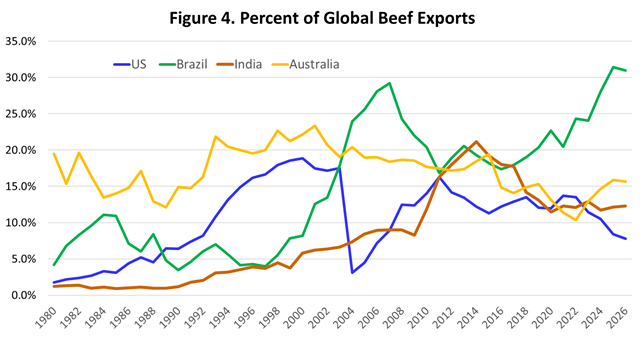
Shares of global beef exports have been quite volatile over time (Figure 4). Prior to 2004, Australia was consistently the largest beef exporter. Brazil grew rapidly after 1998 and overtook Australia from 2004-2010. Between 2011 and 2017, Australia, Brazil and India were all jockeying to be the dominant beef exporter, with India the largest in 2014 and 2016 and Australia the largest fractionally in 2015. Since 2018, Brazil has dominated global beef exports with a growing share exceeding 30 percent in 2025. The U.S. has varied from the second to the fourth largest beef exporter since 1980.