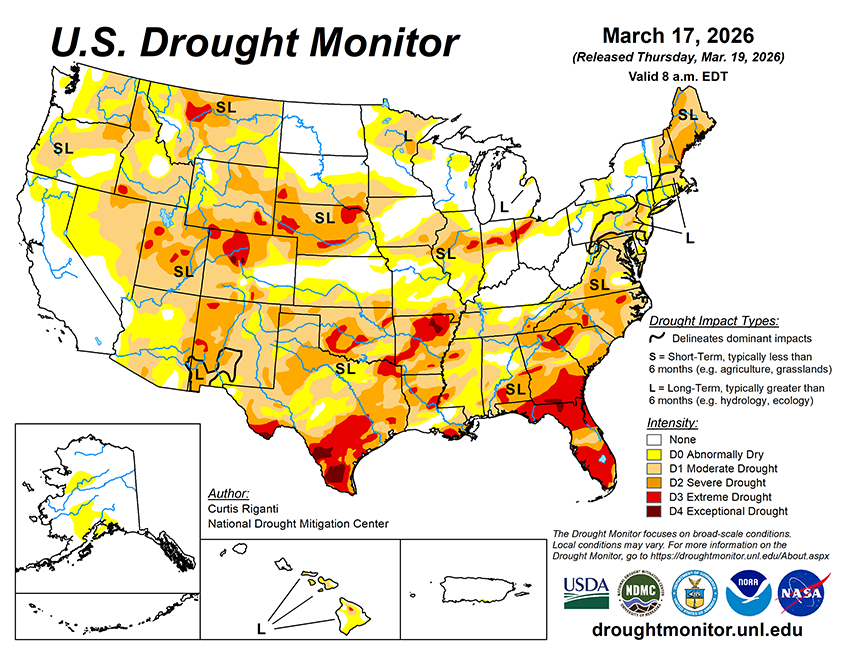
Weekly Drought Monitor for the Week ending 3/17/26

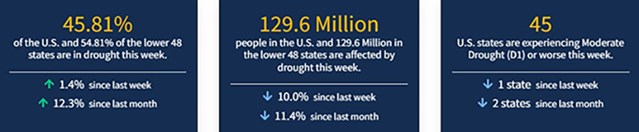
The West saw huge areas worsen this week, particularly in Nevada, Arizona, Colorado, and New Mexico. Parts of the Plains also experienced worsening drought, including South Dakota, Nebraska, and Kansas. The Midwest saw the most improvements for the second week in a row. As of March 17, 2026, 45.81% of the United States and Puerto Rico and 54.81% of the Lower 48 states are in drought.
Drought in the Lower 48 States increased 1.4% since last week and increased 12.3% since last month.

This Week's Drought Summary…

This week, a powerful storm system crossed from the Great Plains into the Great Lakes, bringing widespread rain and thunderstorms to parts of the Midwest, and a historic blizzard to portions of the Upper Midwest, especially in northern Wisconsin and Michigan near Lake Superior. Total precipitation amounts exceeded 2 inches in a large area of the western Great Lakes, while lighter amounts, mostly 0.5-3 inches of precipitation, fell across parts of the southern and eastern Contiguous U.S. Improvements to ongoing drought and dryness occurred across large portions of the Midwest, parts of the lower Mississippi River Valley, and in the Northeast outside of northern New England. Heavy rain and, in some areas, mountain snow, fell across parts of the Northwest, locally improving drought conditions. However, significant deficits in snow still exist in many parts of the West, including the Pacific Northwest, which limited the longer-term benefits of the precipitation that fell.
Much of the Southwest, and the central and southern Great Plains, missed out on precipitation, and instead dealt with a dry, warm and windy week. Precipitation deficits, and lack of snowpack in the mountains, continued to worsen amid high evaporative demand, leading to widespread worsening of abnormal dryness and drought, especially in South Dakota and Nebraska, southwest Kansas, southern Colorado, New Mexico, Arizona, Nevada, and parts of Oregon that missed out on precipitation. A kona low delivered heavy precipitation to all of Hawaii this week, leading to widespread 1- and local 2-category improvements to ongoing drought conditions from Molokai eastward.


Looking Ahead...

Through the evening of Monday, March 23, the National Weather Service Weather Prediction Center’s forecast depicts mostly dry weather across a large swath of the Contiguous U.S. Precipitation totaling 0.5-1 inch may fall from West Virginia into New York, and in spots in New England. Similar precipitation amounts are forecast in parts of northwest Montana and the Idaho Panhandle. Western Washington is forecast to receive widespread precipitation amounts of at least 1 inch, with some favored mountainous areas forecast to receive 2.5-5 inches of precipitation (or locally more). Elsewhere, the forecast calls for precipitation amounts to remain at or below 0.5 inches, with most of the Great Plains, Mississippi and Lower Ohio River Valleys, and the Gulf Coast states likely to remain completely dry.
Looking ahead from March 24-28, the National Weather Service Climate Prediction Center forecast strongly favors warmer-than-normal temperatures in most of the West, especially in the Southwest, and across much of the Great Plains and South. Near- or below-normal temperatures are favored from northern North Dakota eastward through the Great Lakes into much of the Northeast. Above-normal precipitation is favored in Washington, northern Oregon, the Idaho Panhandle and northwest Montana, and from northern Michigan eastward across the northern half of the Northeast. Wetter-than-normal weather is also forecast in central and southern Florida. Elsewhere in the contiguous United States, below-normal precipitation is more likely, especially from the Great Plains to Utah, Nevada, the Desert Southwest and California.