Weekly Drought Monitor for the Week ending 2/24/26

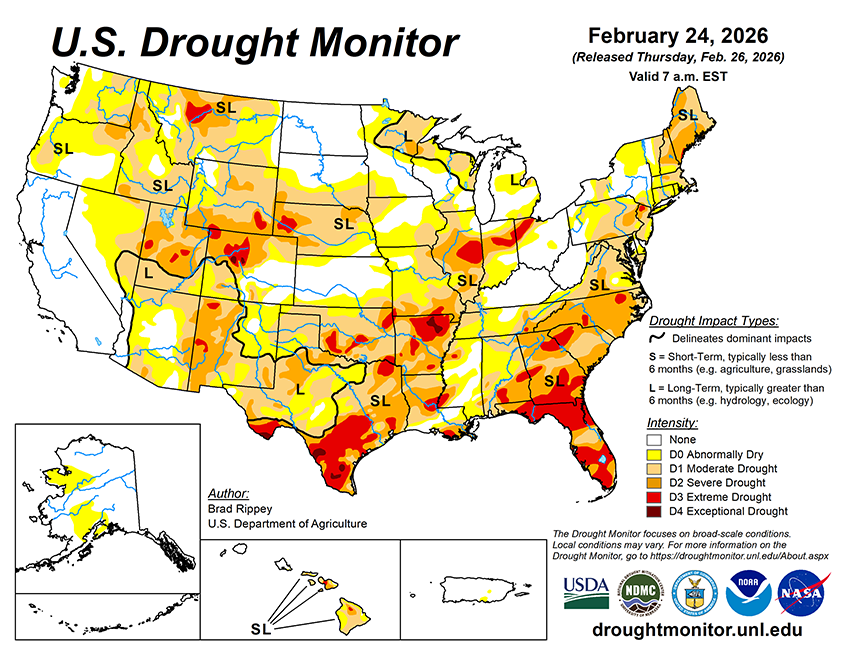
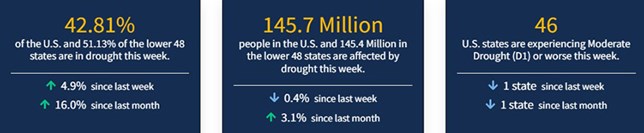
Drought worsened in every state in the Plains (except North Dakota). Scattered parts of the Midwest, South, Southeast, and West also experienced degradations. Meanwhile, drought improved in parts of the Mid-Atlantic and Great Lakes regions. As of February 24, 2026, 42.81% of the United States and Puerto Rico and 51.13% of the Lower 48 states are in drought.
Drought in the Lower 48 States increased 4.9% since last week and 16% since last month.

This Week's Drought Summary…

Stormy, briefly colder weather in California and elsewhere in the West helped to improve previously meager mountain snowpack, with an average of approximately 6 inches of snow-water equivalency being added to the Sierra Nevada. However, 4- to 8-foot snowfall totals in the Sierra Nevada also led to travel disruptions through mountain passes and contributed to the nation’s deadliest avalanche—northwest of Lake Tahoe—in 45 years. Meanwhile, the nation’s mid-section faced several days with record-setting warmth and gusty winds. Portions of the central and southern High Plains endured a rash of wildfires, starting on February 17, with the largest—the Ranger Road Fire—quickly consuming more than 280,000 acres of cured vegetation in northwestern Oklahoma and southwestern Kansas. Initial reports indicated that there were also livestock losses and property destruction. In contrast, several rounds of storminess affected the eastern U.S., culminating in a late-winter blizzard along the middle and northern Atlantic Coast on February 22-23. The winter storm deposited more than a foot of snow in major East Coast cities from Philadelphia to Boston, with a single-storm record of 37.9 inches measured in Providence, Rhode Island. Earlier, an early-season outbreak of severe weather occurred on February 19, when as many as a dozen tornadoes were reported in Illinois and Indiana.


Looking Ahead...

Fast-moving, loosely organized disturbances will traverse the country during the next 5 days. Some of the heaviest precipitation, locally 1 to 2 inches or more, should fall in the Southeast, mainly through Friday. Beneficial showers will linger into the weekend across Florida’s peninsula. In contrast, dry weather will prevail during the next 5 days in the nation’s southwestern quadrant, from southern California to the central and southern High Plains. Record-setting warmth will accompany the dry weather, with temperatures routinely topping 90°F in southern Texas and the Desert Southwest. Farther north, a new plume of Pacific moisture will arrive on Saturday across southern Oregon and northern California. That moisture will race eastward, sparking wintry precipitation by Sunday and Monday from the central Plains into the mid-Atlantic, including the Ohio Valley and neighboring regions.
The NWS 6- to 10-day outlook for March 3 – 7 calls for the likelihood of warmer-than-normal weather nationwide, except for near- or below-normal temperatures in parts of New York and much of New England. Meanwhile, near- or above-normal precipitation across most of the country should contrast with drier-than-normal conditions in coastal North Carolina and portions of the Far West, including California and the western Great Basin.