The best thing politicians can do to help cattle and beef markets is to shut up and let the markets work. If you want to help, stop trying to help.
Derrell S. Peel, Oklahoma State University
Beef prices have become, unfortunately, the federal poster child for high food prices and concerns about consumer affordability. Much political attention is focused on high beef prices as part of broader inflationary concerns among numerous food items – resulting from tariffs and other macroeconomic factors. Ironically, high beef prices are only coincidentally contributing to inflation concerns in that beef prices are high because of internal beef market fundamentals rather than systemic inflation factors. Strong beef supply and demand fundamentals mean that beef prices would be high even if there were no other inflation or macroeconomic concerns.
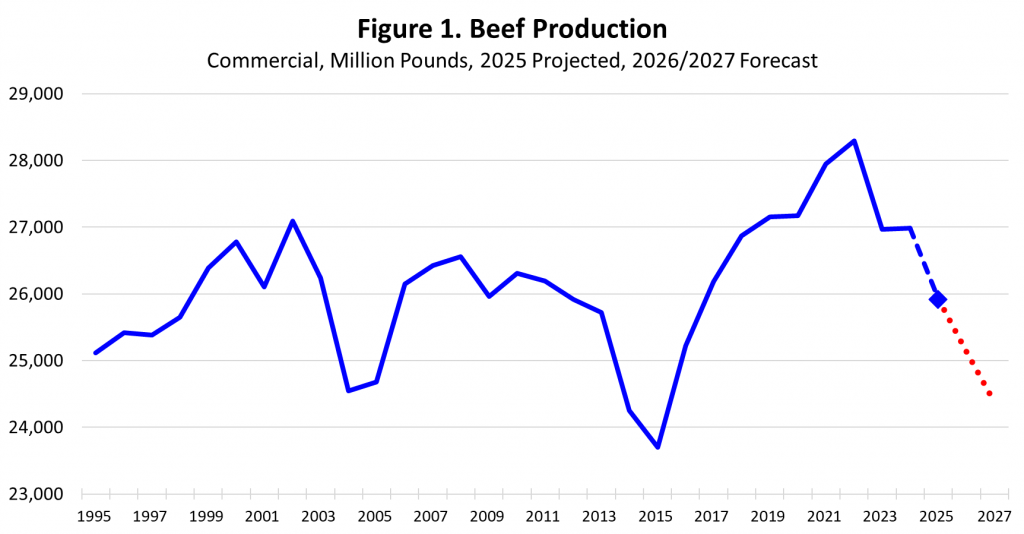
Beef production is down year over year in 2025 and expected to decrease further in the next two years (Figure1 above). Decreased beef production is the result of smaller U.S. calf crops for seven consecutive years since 2018. The feeder cattle supply continues to tighten as a result, leading to lower feedlot production, decreased cattle slaughter and lower beef production. The beef cow herd may stabilize temporarily into 2026 as a result of decreased beef cow culling in the last three years. However, there is currently no indication of significant heifer retention, and it will not be possible to hold the herd inventory stable, and certainly not to rebuild inventories, without additional heifer retention. Therefore, beef production is expected continue decreasing for the next couple years…likely leading to even higher beef prices.
No matter how much they would like to lower beef prices, there is essentially nothing that politicians can do to change the beef market reality. Beef imports are not the answer. The market is already responding to tight supply conditions with beef imports sharply higher in 2025. Lower beef import tariffs in the latest version of spin-the-wheel trade policies will allow the market to function more effectively and may slightly moderate processing beef costs in the ground beef market. However, imports are unlikely to have much additional noticeable impact going forward and certainly will not affect the majority of beef cut prices at retail. Likewise, any sort of cattle production incentives will not speed up the time it takes to breed, grow and finish cattle for beef production. Revolving door packer investigations are unlikely to find anything different that multiple previous investigations – nothing – and, in any event, would not speed up beef production.
Under the best of circumstances, it will take 2-4 years for enough herd rebuilding to significantly increase domestic beef production. Cattle producers, already nervous and trying to deal with debilitating cattle market volatility and uncertainty, are further spooked every time politicians talk about imports, packer investigations, or any other market meddling that comes to mind. Such political talk further delays producer plans and actions to respond to market signals and start the process of herd rebuilding. Markets are remarkably efficient at fixing economic problems…when they are allowed to work. There is no quick and easy way to lower beef prices, but political rhetoric is making the process even slower. Frankly, the best thing politicians can do to help cattle and beef markets is to shut up and let the markets work. If you want to help, stop trying to help.