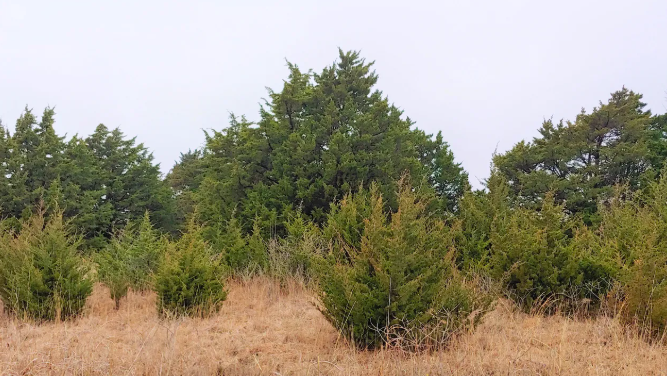
INVASIVE SPECIES: The eastern red cedar is contributing to the spread of another problematic species in the state, the lone star tick.
Alisa Boswell-Gore, Agricultural Communications Services, Oklahoma State University
An Oklahoma invasive species has become a haven for another problematic species, which has the potential to create a range of problems for human, wildlife and livestock health, as well as the environment.
Native to the rocky areas of eastern Oklahoma, eastern red cedar has been documented spreading through grasslands across the state, which affects rangeland quality and livestock productivity, and has negative impacts on water resources. According to studies, the trees spread by 40 square miles per year in Oklahoma.
Eastern red cedars use a significant amount of water, which reduces the amount of water running off into streams and reservoirs where it is needed. Once it is established, eastern red cedar also proves to be a highly flammable fuel for wildfires.
Lone star tick
Now, ticks, particularly the lone star tick, are also spreading into western Oklahoma. This is not a coincidence, said Scott Loss, Oklahoma State University professor of natural resource ecology and management, and Bruce Noden, OSU professor of entomology.
Noden and graduate student Jozlyn Propst found evidence that the expansion of eastern red cedar across the state into the western grasslands is contributing to the spread of ticks by creating a hospitable environment that allows them to thrive.
“When I first came to Oklahoma in 2014, we conducted surveys, and surprisingly, we found lone star ticks all the way out to the western border of Oklahoma,” Noden said.
The lone star tick is the primary species that carries alpha-gal syndrome, a condition that causes a person to become allergic to red meat.
“I was talking to an agricultural producer in western Oklahoma, and I asked him where he would find ticks on his property, and he said, ‘Everybody knows they’re down in the cedars,’” Noden said. “It was common knowledge among cattle producers, but no one had put some science behind it yet.”
High humidity
Noden began asking the question of how the lone star tick — which needs high humidity levels — survives in the dry, western areas of Oklahoma. Propst said eastern red cedar creates a “humidity dome” for the tick, making the area under red cedar trees moister than the surrounding environment and allowing the insects to remain alive until they can attach to wildlife.
Loss said that while they have not yet evaluated how eastern red cedar affects the ability of ticks to find host blood meals, he is sure there is a wildlife and livestock angle, where the ticks are attaching themselves to animals that frequent areas with the cedar trees.
“It could be deer, small mammals, birds or any number of animals that they are finding as resources within eastern red cedar trees,” Loss said. “You go into an arid environment like western Oklahoma in the summertime, and it’s obvious that it feels cooler and more humid during the day under red cedar trees, making it evident that the trees are changing the microclimates and habitats.”
Loss said natural resource ecology and management graduate student Landon Neumann recently published a study confirming that the microclimate of grasslands changes with the invasion of cedar trees.
“There is certainly evidence now that areas with eastern red cedar retain moisture more consistently and return it to the atmosphere as water vapor, which is creating the new microclimates,” Loss said.
Tick-borne pathogens
Noden, Propst and Loss are also researching the potential for tick-borne pathogens to increase due to the expansion of eastern red cedar trees.
“In addition to supporting pathogen-infected ticks, we have also found that most of the West Nile Virus-infected mosquitoes that we’ve collected have been found in cedar,” Noden said, “so that’s another disease angle, which makes sense because the climate created by the trees would also be hospitable for mosquitoes.”
Loss and Noden said their hope is that their research can inform property managers and landowners about the risks of not managing eastern red cedar on their property, including the risk of tick-borne disease transmission to humans and livestock.
“We hope future studies will provide an understanding of how red cedar may be central to supporting the hosts that ticks and mosquitoes are feeding on and contributing to the survival of arthropods in hot, dry areas of the state,” Noden said.