James Mitchell, University of Arkansas
The 43-day government shutdown ended on November 13, and the U.S. Department of Agriculture is now working through the backlog of data that went unreleased during that period. Of particular importance for cattle markets were the October and November Cattle on Feed numbers, which Josh summarized in last week’s article. USDA has also resumed publishing cattle slaughter data. Weekly total cattle slaughter is now current for the week ending November 29, though slaughter by class of animal lags by two weeks, which is normal.
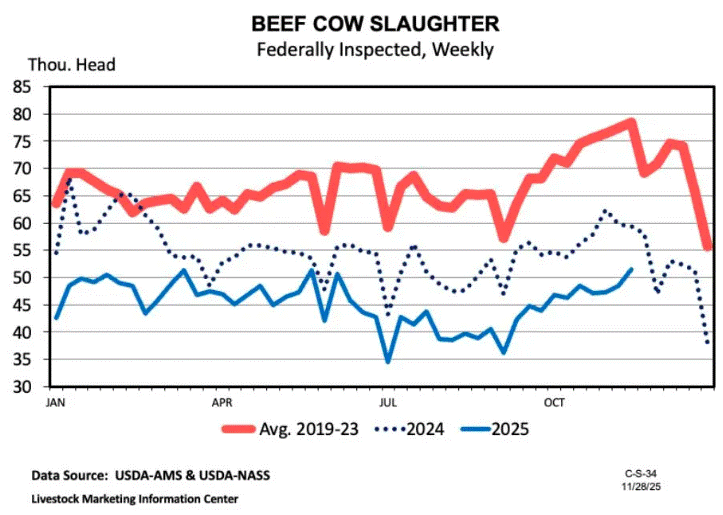
Tracking beef cow slaughter during the second half of the year is a good indicator of the seasonal peak in cow culling that occurs each fall, as well as any signs of early, drought-induced culling. Through November 15, beef cow slaughter totals 2.09 million head, down 18% from the same period in 2024. Fall beef cow slaughter has generally followed the pace observed earlier in the year. Looking at the 12 most recent weeks of data, from the week ending August 30 through week ending November 15, beef cow slaughter totaled 543,586 head, which is 19% lower than the same 12-week period in 2024.
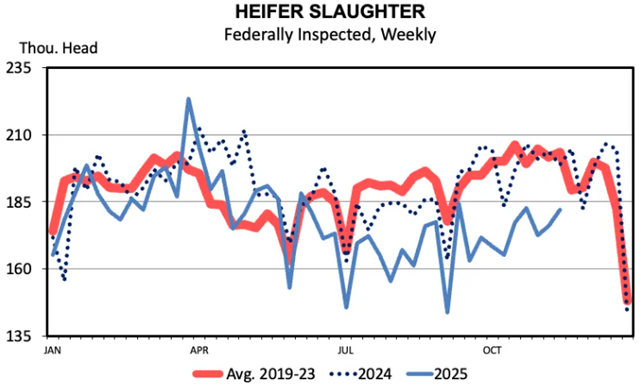
Heifer slaughter data, when combined with information from other reports such as the quarterly number of heifers on feed that Josh covered last week, provides an important signal of heifer retention. Through the week ending November 15, heifer slaughter totals 8.21 million head, down 6% compared to 2024. At this pace, total heifer slaughter for 2025 would be about 9.40 million head, which would be the lowest annual total since 2018 but still 2.05 million head higher than the low for the current cattle cycle, which occurred in 2015.
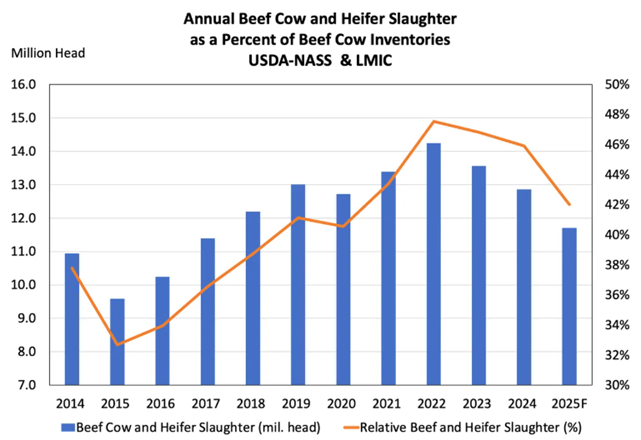
Beef cow and heifer slaughter could be lower this year, simply because cattle inventories are historically tight and fewer animals are available for slaughter. A more informative measure than slaughter totals alone is slaughter relative to the size of the beef cow inventory. Relative to January 1 beef cow inventories, we are on pace for beef cow and heifer slaughter to equal about 42% of the beef cow herd. The third graph in this article provides perspective on how this estimate compares across the current cattle cycle. Historically, based on this model, this rate would need to fall below 40% before we would expect a year-over-year increase in beef cow inventories. This is just one framework for evaluating where inventories may head, and it should be considered alongside other indicators of herd rebuilding.